
About This Project
As a capstone project for UCLA’s Digital Humanities 101, our project aims to explore the adverse effects of disciplinary action in American public schools on marginalized groups. Specifically, African American students and students with disabilities. Furthermore, by utilizing data from the 2017-2018 Civil Rights Data Collection (CRDC) Office for Civil Rights, we aim to unveil the underlying historical and systematic factors exacerbating these disparities.

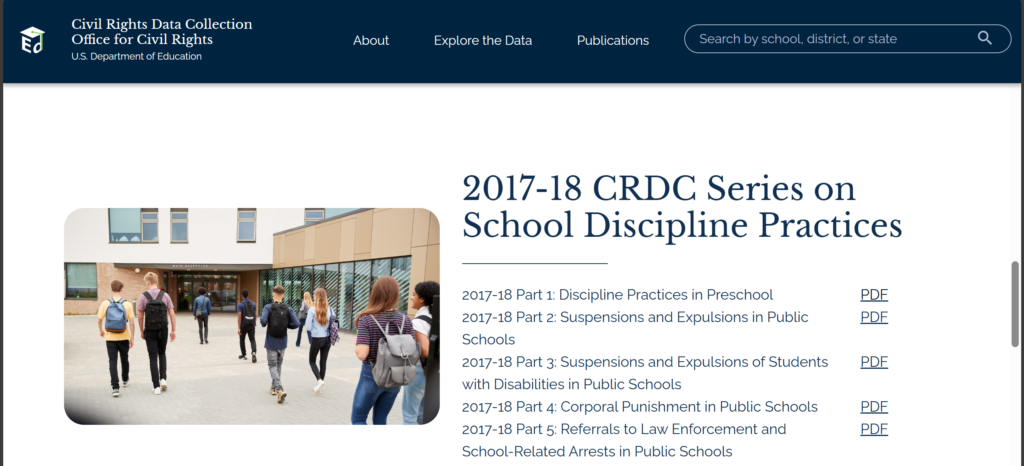
The series consists of 5 parts on discipline practices, supensions and expulsions, corporal punishments, and referalls to law enforcement and school-related arrests.
Timeline
At the core of our narrative consists of three intersectional, guiding research questions. Our team created and revised these research questions alongside the creation of our project’s visualizations and narrative research. We encourage, after reading our questions, to look into the timeline of the American public school system’s disproportionate usage of disciplinary action against marginalized groups of color and towards students with disabilities.
Question 1
How do disciplinary actions implemented in American public schools adversely affect marginalized groups such as African American students and students with disabilities?
Question 2
What historical and systemic factors, such as segregation, funding disparities, and discriminatory policies, contribute to the disproportionate disciplinary actions against African American students and students with disabilities in American public schools?
How do these factors affect these students’ academic achievement?
Question 3
How do out-of-school suspension rates for students with disabilities compare across different racial/ethnic groups in American public schools? What insights can be drawn from these comparisons about broader patterns of inequality?

Before entering our narrative, we encourage you to read the following terms and definitions as defined by the Civil Rights Data Collection (CRDC).
Introducing the Narrative
Factors such as funding inequalities and discriminatory policies not only perpetuate inequality, but impede academic achievement for affected students. The CRDC demonstrates that the marginalized groups that face the highest national rate of student disciplinary actions are: White, Latino, and African American. Students with disabilities also experience the same disproportionately high rates of disciplinary measures.
This demonstrates the urgent need to shed light on the need for substantial policy reform. Change ensures an equal and supportive educational environment that encourages academic achievement for all students. Through these data collections, we can see that there is a correlation between disciplinary actions and how they affect African American students and students with disabilities.
Our project examines the correlation between disciplinary practices implemented in American public schools and marginalized groups, including African American students and students with disabilities. This question aims to look further into whether there is a direct relationship between the number of disciplinary actions and the likelihood of students staying in school until graduation. We also want to tackle the question of whether race has anything to do with student disciplinary and retention rates.
By using the data provided by “Civil Rights Data Collection Office for Civil Rights”, it is shown that the race that faces the highest rate of student disciplinary actions nationally are: White, Latino, and African American. In the student retention data, the races with the highest rates of student retention are also White, Hispanic/Latino, and black/African American. Through these data collections, we can see that there is a correlation between disciplinary actions and how they affect student retention rates in secondary education.
CRDC 2017-2018: Terms and Definitions
IDEA Student
Are students with disabilities served under the Individuals with Disabilities Education Act (IDEA). Read more through the U.S. Department of Education’s website.
In-School Suspension
Is an instance in which a child is temporarily removed from his or her regular classroom(s) for at least half a day for disciplinary purposes, but remains under the direct supervision of school personnel. Direct supervision means school personnel are physically in the same location as students under their supervision.
Out-Of-School Suspension
For students with disabilities served under IDEA:
Out-of-school suspension is an instance in which a child is temporarily removed from his/her regular school for at least half a day for disciplinary purposes to another setting (e.g., home, behavior center). Out-of-school suspensions include both removals in which no individualized family service plan (IFSP) or individualized education plan (IEP) services are provided because the removal is 10 days or less as well as removals in which the child continues to receive services according to his/her IFSP or IEP.
For students without disabilities and students with disabilities served solely under Section 504 of the Rehabilitation Act:
Out-of-school suspension is an instance in which a child is temporarily removed from his/her regular school for at least half a day (but less than the remainder of the school year) for disciplinary purposes to another setting (e.g., home, behavior center). Out-of-school suspensions include removals in which no educational services are provided, and removals in which educational services are provided (e.g., school provided at home instruction or tutoring).
If you are interested, we highly encourage reading the CRDC’s Master List of Definitions from 2017-2018. The list expands beyond the three provided above.
Data Critique
Our narrative consists of a plethora of visualizations and maps which utilize the Civil Rights Data Collection (CRDC)’s datasets. To thoroughly address our research questions, it is crucial to engage in a detailed critique of the data. This critique allows us to understand both the strengths and limitations of the CRDC datasets, providing context to our findings and approach behind our interpretations.

Resources
Lastly, our team is passionate about making data accessible to everyone.
We provide a publicly accessible data file, comprised of the datasets used in our project. Our resources page includes additional information on the data visualization tools, programs, and applications we used to analyze and present the data. We also offer an annotated bibliography highlighting our most relevant sources and a comprehensive bibliography that lists all sources consulted in our research.
These resources are designed to support further investigation and encourage informed discussions on educational equity.